Fox19: Ticks on rise across Tristate
UC expert explains risks of tick-borne illness in Cincinnati

Fox19 visited the biology lab of a University of Cincinnati professor to learn more about the growing risks of tick-borne illness across Greater Cincinnati.
UC College of Arts and Sciences Professor Joshua Benoit studies ticks, mosquitoes and other pests that can transmit disease to people to learn about the health risks to people and ways to mitigate them.
Benoit told Fox19 that Cincinnati is seeing new species of ticks than historically called the area home.
“We never used to have Gulf Coast ticks in Cincinnati. We're also seeing black-legged ticks, which act as reservoirs for Lyme disease,” Benoit said.

A UC student holds up a tick in a vial in a biology lab. Photo/Jay Yocis/UC
Lyme disease is found across the country from Maine to California, according to the Centers for Disease Control and Prevention. But the highest rates of cases are found in the Northeast and northern states from Indiana to North Dakota.
Lyme disease often carries symptoms such as fever, headache, fatigue and joint pain. If left untreated, it can spread to the heart and nervous system. Treatment typically consists of antibiotics.
“Historically, this part of Ohio had an absence of ticks. Now we're seeing at least three different species regularly in our collections.”
In his surveillance program, Benoit has observed above-average numbers of ticks this year.
“It's been really wet. We had a mild winter. That's seems to be the perfect combination,” Benoit said.
Ticks are often found in tall grass. They use their front legs to latch onto passing people or animals. But ticks that are removed quickly do not have time to transmit infection.
“Make sure you check yourself if you've been outside. If you've been out on a hike, just check yourself,” Benoit said.
If you find one, Benoit said, a pair of tweezers is usually sufficient to remove them.
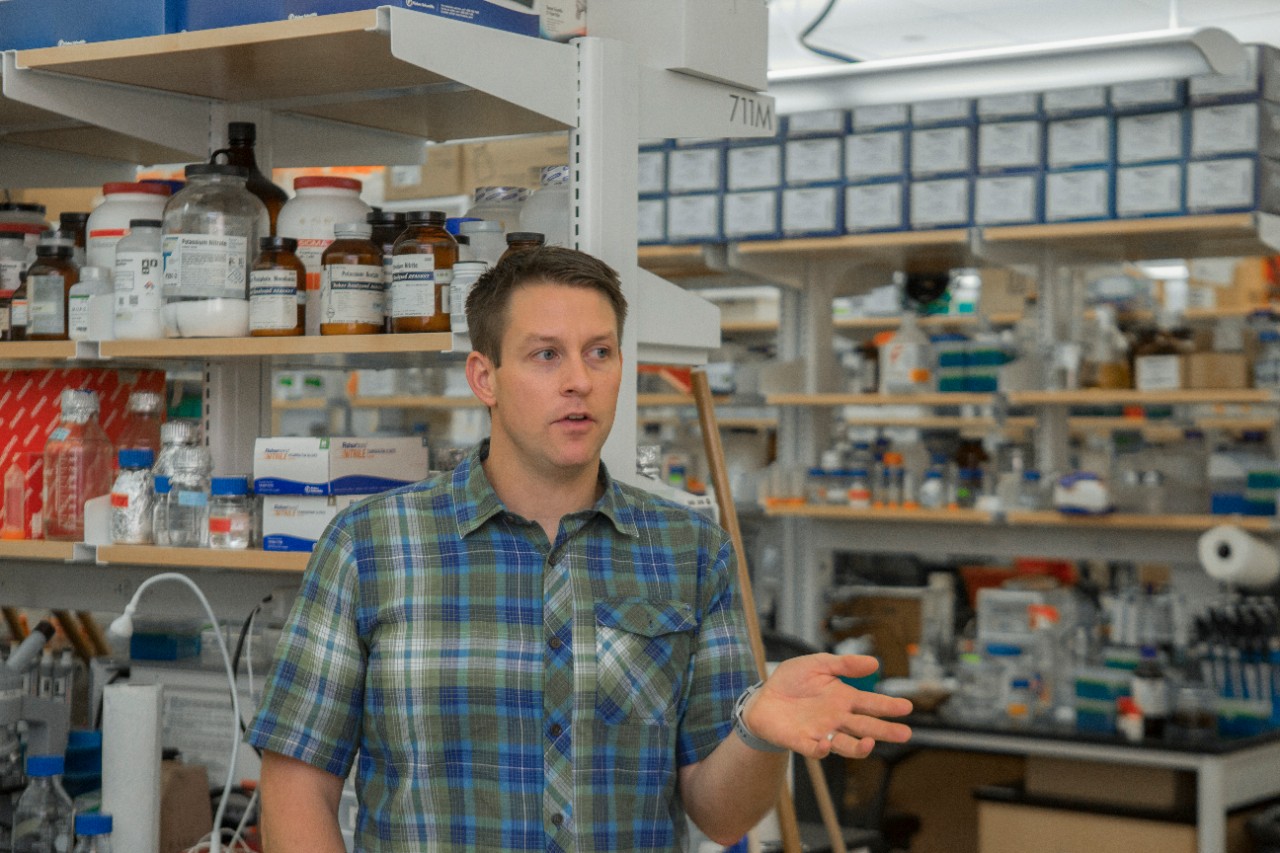
Featured image at top: UC Professor Joshua Benoit studies ticks in his lab. Photo/Joseph Fuqua II/UC
Related Stories
‘Designer drug’ shows early neuroprotective signal in acute ischemic stroke
October 28, 2025

Medscape highlighted new trial results led by the University of Cincinnati's Eva Mistry that found an experimental drug shows promise in protecting injured brain cells for patients with acute ischemic stroke.
Is menstrual fluid ‘the most overlooked opportunity’ in women’s health?
October 27, 2025

The Guardian recently reported that period blood has long been thought of as ‘stinky and useless’, but startups are exploring using the fluid to test for a wide range of health conditions — including endometriosis.
What is squalane, and how does it work to moisturize skin?
October 27, 2025

The University of Cincinnati's Kelly Dobos was featured in a Women's Health article discussing squalane, an ingredient being increasingly used in moisturizing skincare products.