Washington Post: The rise of AI fake news
UC social media expert Jeffrey Blevins makes the media rounds on the topic of fake news

According to an article in the Washington Post, since May 2023, websites hosting AI-created false articles have increased by more than 1,000 percent.
The article focuses on AI having the ability to be a misinformation superspreader and quotes leading misinformation experts, to include UC’s Jeffery Blevins, a professor in both the Department of Journalism and Department of Public and International Affairs (SPIA).
Just because a website claims to be a news organization, doesn’t mean that it has ‘real’ journalists running the operation, Blevins tells The Post, adding that having real and AI-generated news side-by-side makes deceptive stories more believable.
“It’s misleading,” he says, because not everyone is media savvy enough to tell the difference.
And it doesn’t help that AI is becoming easier to use and harder to distinguish whether the news is being generated by a spy agency or a teenager in a basement, the article states.

Photo iStock Photo.
For now, there are still some ways to tell whether an article is written by AI, says Blevins, citing things to look out for that might indicate its AI such as “really odd grammar” or poor sentence construction.
The best way to combat the deception, he says, is to improved media literacy among the average reader.
Blevins is a leading scholar in U.S. telecommunication law and policy, and critical political economy theory and is the co-author of “Social Media, Social Justice and the Political Economy of Online Networks.” He is a trusted media resource, and he has provided expertise on electronic media regulation and Federal Communications Commission policymaking to international, national, regional and local news media.
Read the Washington Post article: The rise of AI fake news is creating a ‘misinformation superspreader’
Blevins was also a cited expert in a Raw Story article: ‘Too preposterous to be real’: College hires ‘pink slime’ publisher as journalism prof
Additionally, Blevins appeared as a guest on Arirang News, Korea's largest English-language television network: War against fake news: S. Korea's one-strike policy
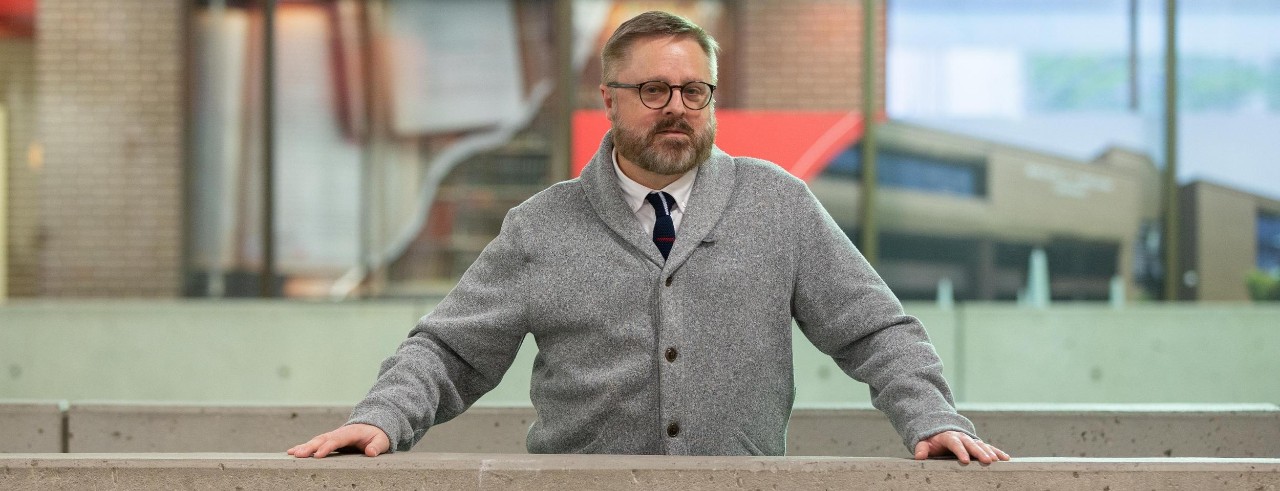
Featured photo at top of Jeffrey Blevins by Andrew Higley/UC Marketing + Brand.
Impact Lives Here
The University of Cincinnati is leading public urban universities into a new era of innovation and impact. Our faculty, staff and students are saving lives, changing outcomes and bending the future in our city's direction. Next Lives Here.
Related Stories
‘Designer drug’ shows early neuroprotective signal in acute ischemic stroke
October 28, 2025

Medscape highlighted new trial results led by the University of Cincinnati's Eva Mistry that found an experimental drug shows promise in protecting injured brain cells for patients with acute ischemic stroke.
Is menstrual fluid ‘the most overlooked opportunity’ in women’s health?
October 27, 2025

The Guardian recently reported that period blood has long been thought of as ‘stinky and useless’, but startups are exploring using the fluid to test for a wide range of health conditions — including endometriosis.
What is squalane, and how does it work to moisturize skin?
October 27, 2025

The University of Cincinnati's Kelly Dobos was featured in a Women's Health article discussing squalane, an ingredient being increasingly used in moisturizing skincare products.