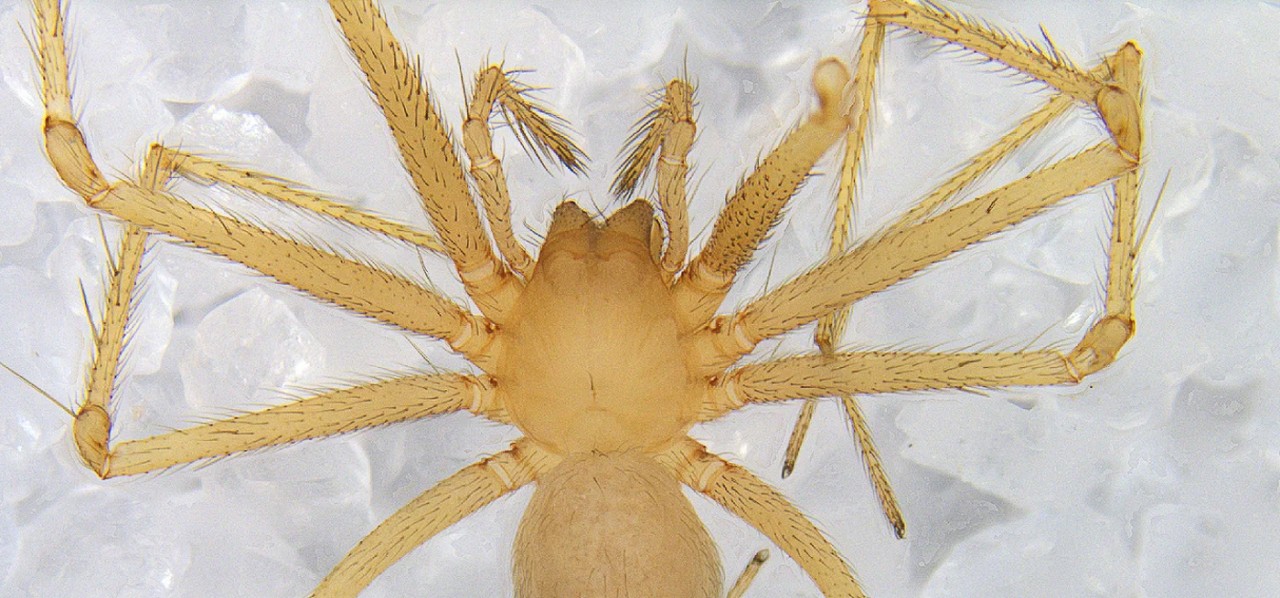
Scientific American: Eyeless spiders can still see light
UC professor explains how cave-dwelling spiders are sensitive to light despite having no eyes

Scientific American turned to a University of Cincinnati professor to help explain how cave-dwelling spiders that have no eyes can still sense light.
Researchers from Hubei University in China found that spiders living deep with caves have lost their eyes altogether similar to the way that blind cave fish have evolved in a world without light.
These eyeless spiders can detect light, perhaps as a defense mechanism so they can remain inconspicuous by moving to the darkest recesses. Researchers found that these sightless spiders retained photoreceptive genes that allowed them to sense changes in light.
UC College of Arts and Sciences Professor Elke Buschbeck studies the vision of spiders, beetles and other invertebrates in her biology lab. Buschbeck, who was not part of the research, told Scientific American that sensing light is fundamental for most living things.
“A lot of organisms can sense light even without eyes,” Buschbeck told Scientific American.
For example, some eyeless crustaceans and blind fish have been observed avoiding light to stay safe in their dark environments. But these cave creatures are not exactly visualizing what’s around them, she said.
“There is an important distinction between sensing changes in ambient light levels and being able to actually see structure in our environment,” Buschbeck says.
The study was published in the journal Science Advances.
Read the Scientific American article.
Featured image at top: An eyeless cave spider can still sense light. Photo/Jie Liu/Hubei University

UC Professor Elke Buschbeck studies animal vision in her biology lab. Photo/Andrew Higley/UC Marketing + Brand
Related Stories
‘Designer drug’ shows early neuroprotective signal in acute ischemic stroke
October 28, 2025

Medscape highlighted new trial results led by the University of Cincinnati's Eva Mistry that found an experimental drug shows promise in protecting injured brain cells for patients with acute ischemic stroke.
Is menstrual fluid ‘the most overlooked opportunity’ in women’s health?
October 27, 2025

The Guardian recently reported that period blood has long been thought of as ‘stinky and useless’, but startups are exploring using the fluid to test for a wide range of health conditions — including endometriosis.
What is squalane, and how does it work to moisturize skin?
October 27, 2025

The University of Cincinnati's Kelly Dobos was featured in a Women's Health article discussing squalane, an ingredient being increasingly used in moisturizing skincare products.