Sensors & Diagnostics: At-home test protects oral health
Journal highlights UC research in quarterly newsletter

The journal Sensors & Diagnostics highlighted a University of Cincinnati research project in its quarterly newsletter.
UC College of Engineering and Applied Science Professor Andrew Steckl and his research partners developed a new device that can warn consumers about early risks of tooth decay from diseases such as gingivitis and periodontitis.
Steckl and UC Senior Research Associate Daewoo Han collaborated with Sancai Xie, a principal scientist at Procter & Gamble Co.
“There are good reasons to use saliva,” he said. “It’s relatively plentiful and easy to obtain through noninvasive methods. And saliva has a lot of important elements that can act as indicators of your health.”
Bacteria from gingivitis can travel through the bloodstream, leading to cardiovascular disease and other serious health problems, Steckl said.
At-home health testing has been available for generations for uses such as detecting pregnancy. But the COVID-19 pandemic introduced a wide audience of consumers to the concept of monitoring their health with new technology.
The at-home testing industry is expected to generate $45 billion annually by 2031, according to Allied Market Research.
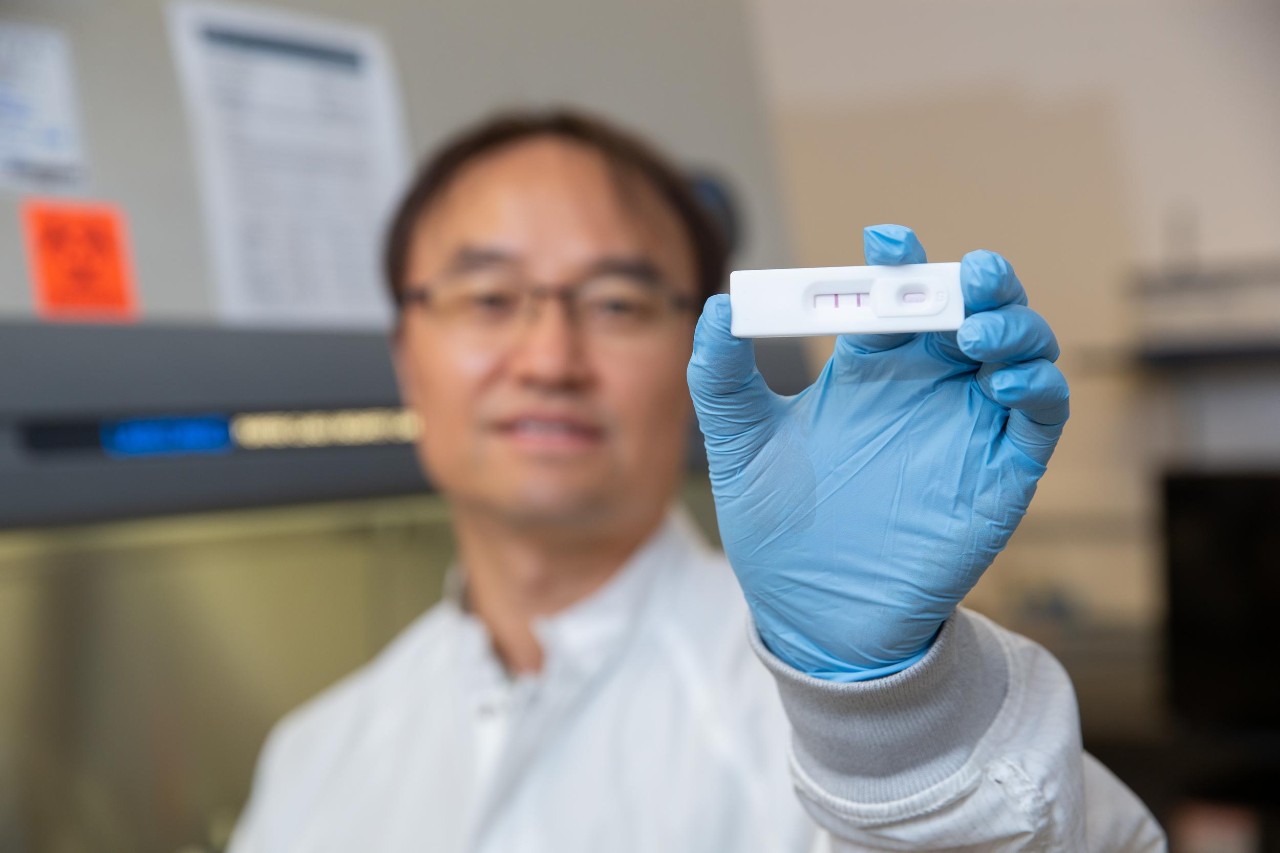
Featured image at top: UC Senior Research Associate Daewoo Han holds up UC's gingivitis test. Photo/Andrew Higley/UC Marketing + Brand
More UC engineering in the news

UC College of Engineering and Applied Science Professor Andrew Steckl is an Ohio Eminent Scholar. Photo/Andrew Higley/UC Marketing + Brand
- New Atlas: Home test kit could soon spot gingivitis
- Bite Magazine: New at-home test for gingivitis protects oral health
- Times of Oman: New test to detect early stages of tooth decay at home
- Science Daily: At-home test for gingivitis protects oral health
- Medical XPress: Engineers create at-home test that can diagnose gingivitis
Related Stories
‘Designer drug’ shows early neuroprotective signal in acute ischemic stroke
October 28, 2025

Medscape highlighted new trial results led by the University of Cincinnati's Eva Mistry that found an experimental drug shows promise in protecting injured brain cells for patients with acute ischemic stroke.
Is menstrual fluid ‘the most overlooked opportunity’ in women’s health?
October 27, 2025

The Guardian recently reported that period blood has long been thought of as ‘stinky and useless’, but startups are exploring using the fluid to test for a wide range of health conditions — including endometriosis.
What is squalane, and how does it work to moisturize skin?
October 27, 2025

The University of Cincinnati's Kelly Dobos was featured in a Women's Health article discussing squalane, an ingredient being increasingly used in moisturizing skincare products.