Enquirer: Food banks struggle with added costs, less donations
UC economist says anxiety about money, uneven financial recovery have contributed to strain

Food banks across the United States are facing challenges, the Cincinnati Enquirer reported, which a University of Cincinnati economist said is in part a result of higher food prices and uncertainty about the future.
The Enquirer reported that the Freestore Foodbank, which distributes food through its food pantries along with neighborhood food pantries and congregate eating locations in the Cincinnati region, is facing a budget crunch. Donations have dropped, and food prices have increased in recent years, resulting in a $3.5 million deficit to end this fiscal year.
While the economy has improved since the COVID-19 pandemic, people have remained anxious about spending, said Dipanjan Chatterjee, an adjunct instructor in the Carl H. Lindner College of Business’ economics department, a Kautz-Uible Economics Institute fellow and a vice president at Forrester, a research and advisory company.
“The average person has higher income from their occupations and greater wealth from their assets,” Chatterjee said, but added, “Consumer sentiment is wallowing in the depths of despair.”
Chatterjee also said the economic recovery didn’t benefit everyone equally. Those whose finances didn’t recover are more likely to need food assistance.
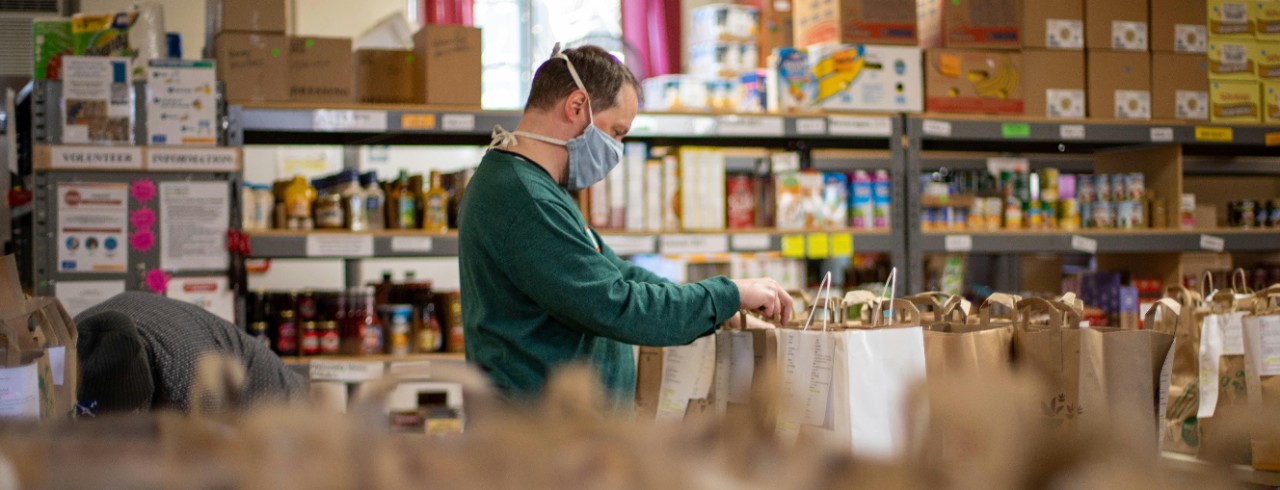
Featured image at top: A person prepares bags of food at a food pantry. Photo/Aaron Doucett via Unsplash
Impact Lives Here
The University of Cincinnati is leading public urban universities into a new era of innovation and impact. Our faculty, staff and students are saving lives, changing outcomes and bending the future in our city's direction. Next Lives Here.
Related Stories
‘Designer drug’ shows early neuroprotective signal in acute ischemic stroke
October 28, 2025

Medscape highlighted new trial results led by the University of Cincinnati's Eva Mistry that found an experimental drug shows promise in protecting injured brain cells for patients with acute ischemic stroke.
Is menstrual fluid ‘the most overlooked opportunity’ in women’s health?
October 27, 2025

The Guardian recently reported that period blood has long been thought of as ‘stinky and useless’, but startups are exploring using the fluid to test for a wide range of health conditions — including endometriosis.
What is squalane, and how does it work to moisturize skin?
October 27, 2025

The University of Cincinnati's Kelly Dobos was featured in a Women's Health article discussing squalane, an ingredient being increasingly used in moisturizing skincare products.