Fox19: UC uses fossils to teach kids about environment
Clifton Area Neighborhood School pays visit to geosciences to learn about STEM

Fox19 covered an elementary school visit to the University of Cincinnati where fifth- and sixth-graders learned about the environment.
Students from the Clifton Area Neighborhood School took part in activities and learned about the latest research by faculty in UC's Department of Geosciences.
The science day is sponsored by UC's Center for Public Engagement with Science.
Professor Brooke Crowley led students in games of Jenga with a sturdy tower of blocks representing high biodiversity and a tippy tower of blocks representing low biodiversity. In her lab, she and her students use isotopic analysis to study long-extinct animals and to help conservationists protect rare and endangered species around the world.
Among her many UC research projects, she has studied goshawks and lemurs in Madagascar, jaguars in Belize and extinct mammoths and mastodons in what is now the United States.
"If we only have a few animals or plants in an ecosystem, it's less stable and you can have ecosystem collapse," she said.

UC Associate Professor Andy Czaja took part in the Geosciences showcase for visiting students at the Clifton Area Neighborhood School. Photo/Joseph Fuqua II/UC
Graduate student Lilja Carden organized the event to showcase UC Geosciences.
Under an enormous mosasaur skeleton suspended from the ceiling, Professor Carlton Brett walked students through a timeline taped to the floor stretching back past the Ice Age, the age of dinosaurs, the Permian-Triassic extinction that killed most life on Earth and the Ordovician Period 485 million years ago that left fossil evidence in Ohio's creeks of the great inland sea that once covered the Midwest.
"Which of these are fossils?" Brett asked the students? "Yes, these are ancient shark teeth that are probably 10 million years old."
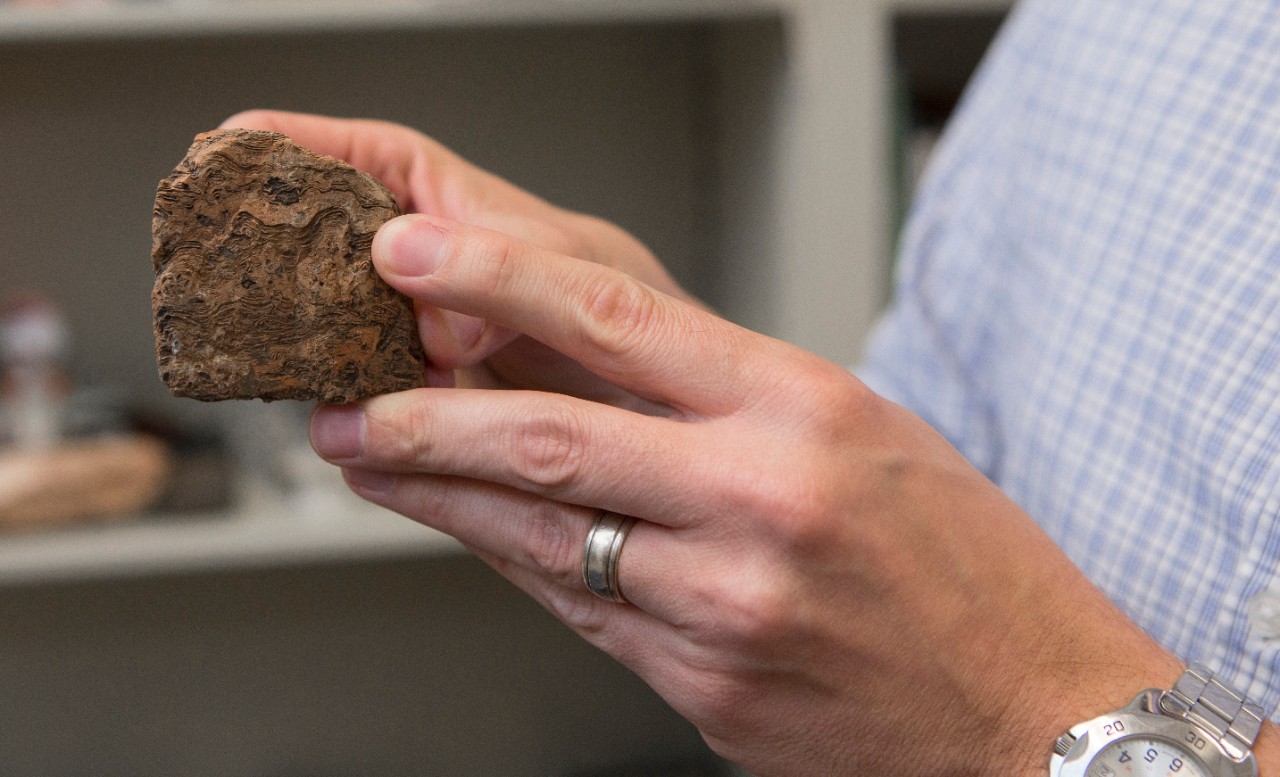
Associate Professor Andy Czaja showed off a model of the Perseverance rover and let students see rare fossils of bacteria dating back 3 billion years. The Earth is about 4.5 billion years old. He is a member of the NASA science team that is using the rover to look for evidence of ancient life on Mars.
Featured image at top: A fossil shows evidence of ancient bacterial life. UC played host to students from the Clifton Area Neighborhood School for a science showcase. Photo/Joseph Fuqua II/UC

UC Professor Brooke Crowley studies both living and extinct animals in her lab. Her research is helping to conserve wildlife around the world. Photo/Jay Yocis/UC
Related Stories
‘Designer drug’ shows early neuroprotective signal in acute ischemic stroke
October 28, 2025

Medscape highlighted new trial results led by the University of Cincinnati's Eva Mistry that found an experimental drug shows promise in protecting injured brain cells for patients with acute ischemic stroke.
Is menstrual fluid ‘the most overlooked opportunity’ in women’s health?
October 27, 2025

The Guardian recently reported that period blood has long been thought of as ‘stinky and useless’, but startups are exploring using the fluid to test for a wide range of health conditions — including endometriosis.
What is squalane, and how does it work to moisturize skin?
October 27, 2025

The University of Cincinnati's Kelly Dobos was featured in a Women's Health article discussing squalane, an ingredient being increasingly used in moisturizing skincare products.