How technology is changing approaches to treat hearing loss
UC expert part of WVXU's Cincinnati Edition panel discussion

According to data from the CDC, more Americans are developing hearing problems earlier in life, yet current devices and treatments can be costly, making them less accessible.
The University of Cincinnati's Daniel Sun, MD, told WVXU's Cincinnati Edition that hearing loss can be thought of like a piano, with different interventions needed based on different situations.
"Hearing loss starts on the right side and slowly works itself toward the left side, toward the bass sounds," said Sun, the Myles L. Pensak, MD, Endowed Professor in Neurotology and Skull Base Surgery, director of the Division of Neurotology, neurotology fellowship program director and associate professor of otolaryngology in the University of Cincinnati College of Medicine, and a UC Health physician. "So the very first things that can be detected...are the very, very right hand side keys of the piano. And then eventually it works itself more and more towards the middle and the left, and that’s when it becomes more noticeable to everyday folks."
The FDA recently authorized new software that can transform Apple’s AirPods Pro 2 into inexpensive hearing aids. Sun said it's a great public health effort to provide hearing aids to more people that need them, but it is not a one-size-fits-all remedy.
"Over the counter hearing aids are only approved for individuals with mild to moderate hearing loss of a specific type, so it’s still important to keep in mind to check with an audiologist or a physician if the hearing loss is more severe," he said. "[If this is] happening at a younger age, get an actual hearing test to determine what may actually be going on."
Over the counter hearing aids, or those built in to AirPods and other headphones, can be thought of like reader glasses you can buy at the drug store without a prescription, but having different hearing between two ears may be a sign you need a formal hearing test from an expert.
Listen to the Cincinnati Edition segment.
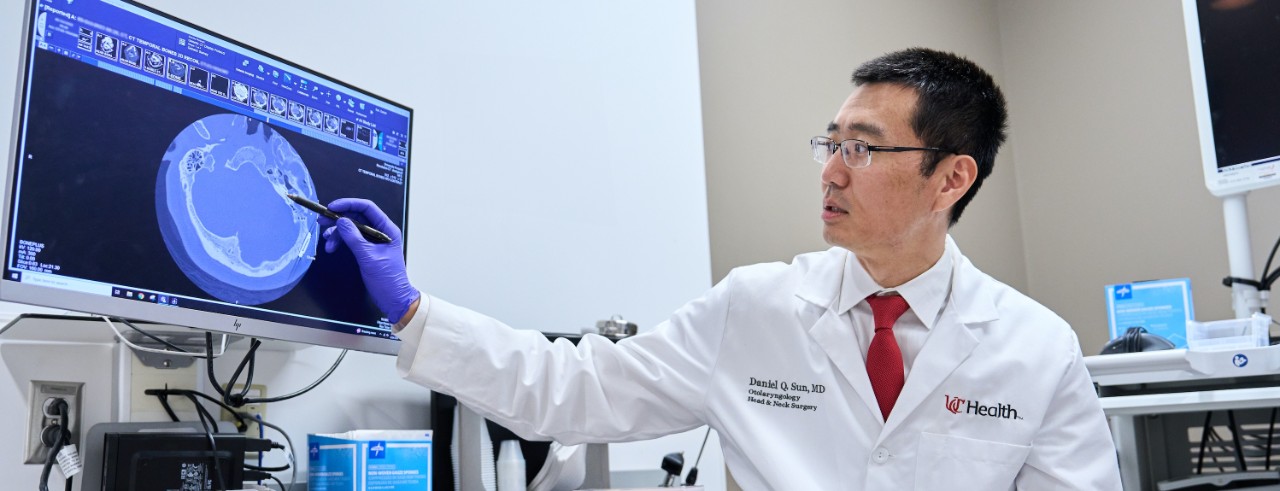
Featured photo at top of Sun pointing to a scan on a monitor. Photo/UC Health.
Related Stories
‘Designer drug’ shows early neuroprotective signal in acute ischemic stroke
October 28, 2025

Medscape highlighted new trial results led by the University of Cincinnati's Eva Mistry that found an experimental drug shows promise in protecting injured brain cells for patients with acute ischemic stroke.
Is menstrual fluid ‘the most overlooked opportunity’ in women’s health?
October 27, 2025

The Guardian recently reported that period blood has long been thought of as ‘stinky and useless’, but startups are exploring using the fluid to test for a wide range of health conditions — including endometriosis.
What is squalane, and how does it work to moisturize skin?
October 27, 2025

The University of Cincinnati's Kelly Dobos was featured in a Women's Health article discussing squalane, an ingredient being increasingly used in moisturizing skincare products.