First DNA from Pompeii victims tells story of volcanic disaster
UC Classics Professor talks to Nature about how science is informing history

Nature turned to a University of Cincinnati Classics professor to explain how science is helping to inform the history of ancient Pompeii, which was buried under ash by the eruption of Mount Vesuvius in 79 A.D.
Researchers at the University of Florence in Italy obtained DNA from bone fragments of five people who died in the eruption. Researchers created plaster casts of the victims of Pompeii from voids in the ash left behind after people were entombed in the disaster.
The casts of the victims long have captured the imaginations of historians and the public in personalizing a disaster of epic proportions.
New DNA analysis of one cast revealed that an adult cradling a child in a dying embrace was not the child's mother, as historians believed, but a man who was unrelated to the child.
The study was published in the journal Current Biology.
Video: UC Classics Professor Steven Ellis discusses the Cincinnati Museum Center's Pompeii: the Exhibition, which ran from February to July this year.
Classics Professor Steven Ellis, who was not part of the latest study, led excavations at Pompeii for UC's College of Arts and Sciences. The first volume of his book “The Porta Stabia Neighborhood at Pompeii” published last year chronicles the findings of his international research team's work.
“What this study does is to remind us that there are indeed myths there to be debunked,” Ellis told Nature.
Ellis said DNA analysis is invaluable in helping us understand the cultures at Pompeii and where residents came from. The DNA analysis confirmed that Pompeii’s population was genetically diverse, featuring descendants of immigrants from the eastern Mediterranean, Nature said.
“We’ve known it from the jewelry that they’re wearing, the cults that they follow, the decorations that adorn the houses,” Ellis said. “But we didn’t really know it from the body casts themselves. Now we do, and that's quite important information.”
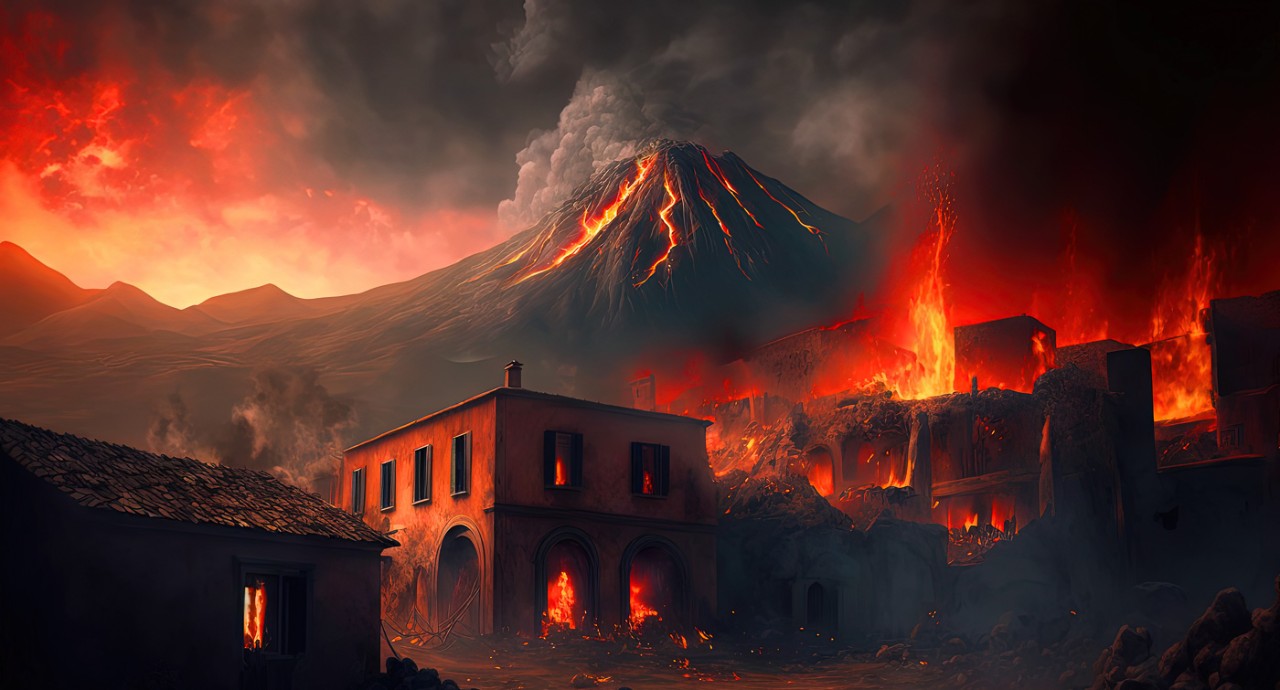
Featured image at top: An illustration created with AI depicts the eruption of Mount Vesuvius at Pompeii. Illustration/Visilli

UC Classics Professor Steven Ellis has published the first volume of "The Porta Stabia Neighborhood at Pompeii" chronicling his international research team's excavations and findings in the ancient Italian city. Photo/Andrew Higley/UC Marketing + Brand
Related Stories
‘Designer drug’ shows early neuroprotective signal in acute ischemic stroke
October 28, 2025

Medscape highlighted new trial results led by the University of Cincinnati's Eva Mistry that found an experimental drug shows promise in protecting injured brain cells for patients with acute ischemic stroke.
Is menstrual fluid ‘the most overlooked opportunity’ in women’s health?
October 27, 2025

The Guardian recently reported that period blood has long been thought of as ‘stinky and useless’, but startups are exploring using the fluid to test for a wide range of health conditions — including endometriosis.
What is squalane, and how does it work to moisturize skin?
October 27, 2025

The University of Cincinnati's Kelly Dobos was featured in a Women's Health article discussing squalane, an ingredient being increasingly used in moisturizing skincare products.