UC expert talks about excavating Pompeii
Classics professor led excavations in city devastated by eruption

A University of Cincinnati professor in a new podcast spoke about the importance of context in archaeological work at the ancient city of Pompeii.
UC Classics Professor Steven Ellis directed archaeological excavations in the Porta Stabia neighborhood in Pompeii, which he hopes is leading to a better understanding of local businesses and the ancient economy before 79 A.D.

UC Classics Professor Steven Ellis shared his team's historical findings in the first volume of their book. Photo/Provided
Pompeii was a coastal city that was engulfed in ash from the eruption of Mount Vesuvius.
Ellis shared his expertise with the podcast When in Rome.
Ellis said previous projects a century ago had cleared ash from the neighborhood where he and his students and international research partners worked. His team set out to learn what preceded the standing buildings to understand how the neighborhood evolved over generations.
The first volume of his book “The Porta Stabia Neighborhood at Pompeii” published in 2023 chronicles the findings of his international research team's work.
“You could tell from the architecture this was a sub-elite neighborhood in the city. It didn’t have the same kinds of large atrium-style buildings of the elite class,” he said. “What is their story? What is their history?”
Ellis said he never loses sight of the tragedy of Pompeii.
“It's hard for us to imagine the scale of that horror,” he said. “With all due respect to people who deal with natural catastrophes, a volcanic eruption of this kind — not only have the people living there never experienced it but they could never have even imagined it.”
Ellis was joined on the podcast by Sophie Hay, archaeologist with the Archaeological Park of Pompeii, who talked about new excavations underway.
“I think what’s great about these two approaches is we get to learn the full story,” Hay said. “We take you down to 79 A.D. levels and his research project comes in and picks up and takes us even farther back to even the sixth century B.C. It’s a beautiful marriage of approaches that in the end gives us the full story of Pompeii.”
When asked about what artifacts he would love to uncover some day, Ellis had a ready answer.
“I always thought it'd be great if Pompeii had something like Rome had which is a marble plan of its city,” he said. “I'm not saying Pompeii had that, but if it did, I would want to find it.”
The podcast When in Rome is available on Apple, Spotify and other streaming services.
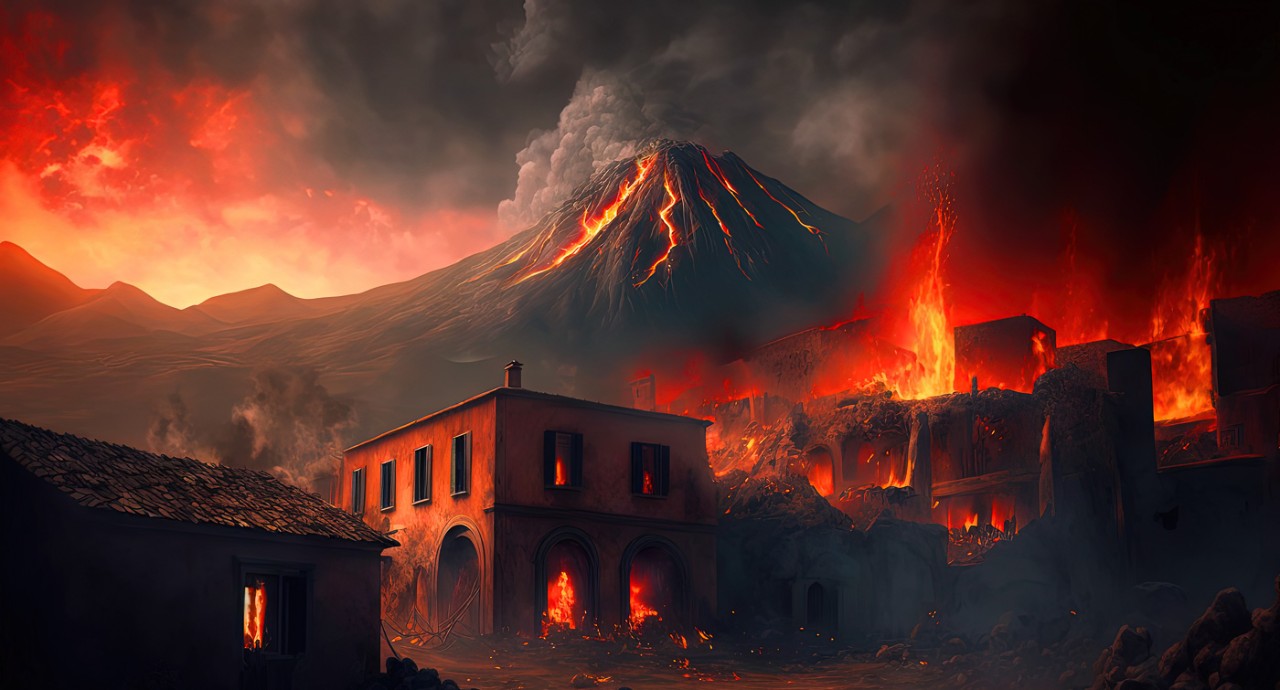
Featured image at top: An illustration created with AI depicts the eruption of Mount Vesuvius at Pompeii. Illustration/Visilli

UC Classics Professor Steven Ellis led excavations of the Porta Stabia neighborhood of Pompeii. Photo/Andrew Higley/UC Marketing + Brand
Related Stories
‘Designer drug’ shows early neuroprotective signal in acute ischemic stroke
October 28, 2025

Medscape highlighted new trial results led by the University of Cincinnati's Eva Mistry that found an experimental drug shows promise in protecting injured brain cells for patients with acute ischemic stroke.
Is menstrual fluid ‘the most overlooked opportunity’ in women’s health?
October 27, 2025

The Guardian recently reported that period blood has long been thought of as ‘stinky and useless’, but startups are exploring using the fluid to test for a wide range of health conditions — including endometriosis.
What is squalane, and how does it work to moisturize skin?
October 27, 2025

The University of Cincinnati's Kelly Dobos was featured in a Women's Health article discussing squalane, an ingredient being increasingly used in moisturizing skincare products.